
Studies will be assigned to a validated Research Ethics Board (REB). This REB of Record will review all submissions related to the study. The process of assigning the REB of Record will differ depending on whether a study is industry-funded or investigator-initiated, and whether it would benefit from a specialized REB.
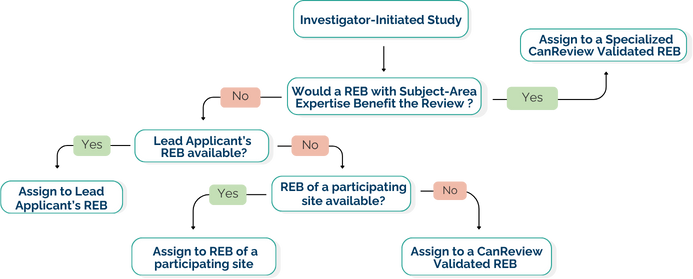
For both Investigator-Initiated and Industry Funded studies, if subject-area expertise would benefit the review process, priority is given to assigning the study to a specialized CanReview REB.
For Investigator-Initiated Studies, CanReview-validated REB at the Lead Applicant’s institution is considered first. If the Lead Applicant’s REB is not available, an REB from a participating site will be considered. If neither option is available, another CanReview REB will be selected through a “next-in-line” equitable distribution process.
Next-In-Line: REB reviews are assigned through a sequential list to maintain an equitable distribution. If an REB does not have capacity, the study is assigned to the next REB in the sequence. The unavailable REB retains its position on the list and will be assigned the next study once capacity becomes available.
For Industry-Funded Studies, the REB of Record is assigned using the same “next in line” equitable distribution process described above.

An assigned REB may decline to review a study if it lacks the relevant subject-matter expertise or cannot meet CanReview’s review timelines.
CanReview will also not assign a study to a REB if institutional policy prohibits it from reviewing the study — for example, if the study is inconsistent with the institution’s mission and values. In these cases, the REB may decline the study.